
Last week, we released an overview of the expected effects of the U.S tariffs on imports in our newsletter – if you haven’t read that yet, you can download it here.
In case you haven’t yet downloaded and read the previous article on the subject of the tariffs, we need to reiterate one very important point from it.
Prices to consumers will go up and demand will go down across most categories in the US
In brief, we outlined in our newsletter that with a price elasticity ratio of 4 and a 0.25 ratio of impact of tariffs on consumer prices (both these numbers estimated by the USTR and shown in the formula for calculating tariffs), the price that consumers pay for a whole array of goods will go up significantly. That will drive a contraction in demand and a significant drop in revenue from the US market for any company doing business there. If you want to read the details of how we arrived at our conclusion, download the newsletter at the link we’d provided above.
Moving on to the topic for this post:
In this post, we wanted to quickly examine what US based companies with significant overseas manufacturing can do to try and retain their market in the US. As we explained in the overview, moving production facilities to the US is not going to be possible in the short or even medium-term.
In order to explore what options US based brands have, we looked at two very different examples.

Nike has significant manufacturing overseas – 95% of shoes and nearly 60% of apparel being made in Asia. However, their are also more diversified in terms of revenue with just over half their sales happening outside the US.
By contrast, General Motors is heavily dependent on the US market for revenue but still has significant imports of parts (49%) and even for finished cars, with one report showing 750,000 cars being imported from Mexico out of the 2.7 million cars GM sold in the US in 2024.
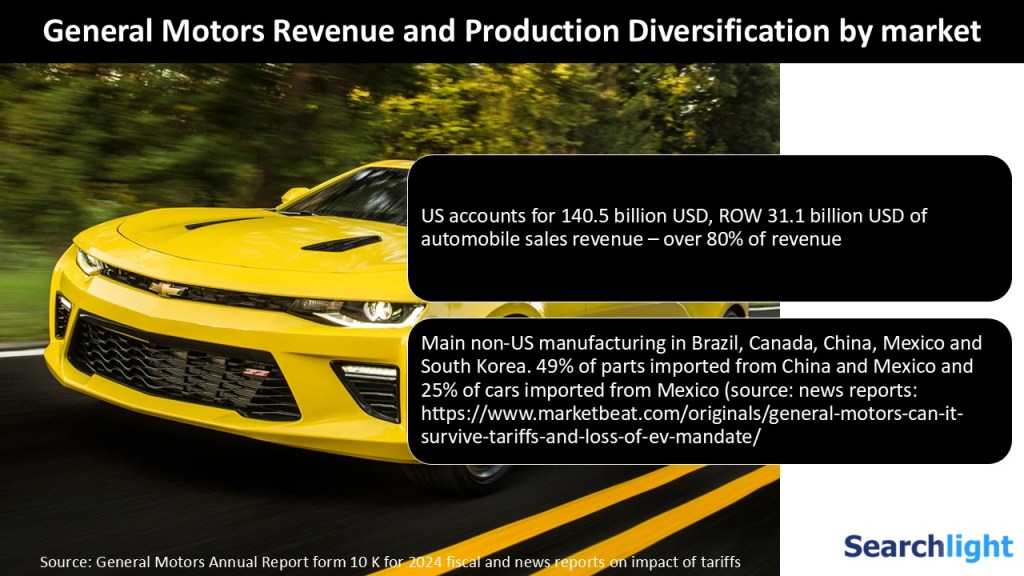
In our newsletter we’d suggested that companies should focus on international expansion since a contraction in consumer demand in the US is inevitable. You can see how this makes sense for Nike, who are already getting 52% of their revenue outside the US. However, it’s going to be a lot harder for GM who get more than 80% of their automobile sales revenue in the US.
In Nike’s case, their best options would be to explore further supply chain efficiencies which can mitigate the effects of tariffs and help them retain as much of their US revenue as possible, while continuing to grow their international revenue and reducing their dependence on the US consumer.
In GM’s case, they’re caught between a rock and a hard place. They clearly are not able to build significant revenue outside the US but are already dependent on the efficiencies that come from manufacturing parts overseas. Perhaps the fact that they’re still assembling a significant proportion of cars in the US, combined with a demonstrated intent to reduce their imports will help them negotiate some concessions on the tariffs they pay for the parts they import. They also have some time before the tariffs on auto parts are imposed, which may allow them to stockpile and focus on assembly entirely within the US for the domestic market.
GM has not been as successful in international markets, as the chart below shows. Trying to suddenly change that and win share in other markets is definitely a hard ask, so their only option is to try and salvage as much of their US business as possible – which means they have to try and do everything they can to minimize the impact of tariffs on consumer prices in the US market. Even with that, the overall rise in consumer prices across the board will definitely cause a contraction of demand for cars and pose a sales challenge for GM and indeed, all the auto majors in the US.

If you run a business that is looking to diversify revenue by growing in China, maybe we can help. We are specialists in helping brands succeed and grow in China and we believe it will continue to be a significant market for the foreseeable future, with a large consumer base and steady economic growth and recovery over the last 15 months. Write to us at enquiries@searchlightchina.com if you’d like to talk further.
 searchlightchina.com